Full Moon Nickel: A Poetry Chapbook
By Rakshithaa V. Jaiganesh / Fall 2025
GRACE
I walk with you–
undefended, unprotected–
witness to your witnessing,
your silent note of thanks.
How you are bathed in
the irreverent kisses of sunshine–
I never knew. I never knew.
I never understood the silence our bodies have always known (held?)
or how sound is borne of consequence:
our shoes, scraping over dirty concrete–
our feet, whispering over old treeskins–
our soles, crinkling over cutlets of fire–
& I will still walk towards you,
unarmed, unguarded,
time unfolding in segments of breath. Four footfalls in.
Five lungfulls out,
the witness to your witnessing,
how you’ll appear to me: small miracle
cloaked in the lovely,
sweet touches of the shade
FERRYBOAT
based on Richard Siken’s 3 Proofs
All painting is sent downstream, into the future. In college one of my professors had us write journals that documented the present because he did not believe in the veracity of the past. In one hundred years he believed the past would be a bright little ferryboat with wonderfully varnished floorboards that never creaked or whispered or betrayed any sign of life. It would bob up and down, peacocking its carcass, dead in the water. The onlookers would point and cheer and take photographs. Then they’d burn the photographs. Then they’d board the next ferry. And so on and so forth. He saw the present as an inflection point. The opportunity to salvage and send basketfuls of newborn truths downriver. This salvaging was left up to us. For two weeks we wrote what we saw in our journals. We wrote about the fishing boats being bombed off the coast of Venezuela. We wrote about the government shutting down. We wrote about people who no longer existed. We wrote about our starving friends. One of my friends was so hungry he tried to kill himself. We stopped him. We could not soothe his starving. Now he is a painting. All painting is sent downstream, but the past stagnates in the water. It lingers. It deceives. It is a Trojan horse, it is a Theseus ship, it is a bright little ferryboat bobbing up and down in the water, it is so many things. But it is never a painting.
ARS POETICA
after Thomas Hitoshi Pruiksma
I leave behind
a poem bookmarked
by a poem
To escape empire,
this poet tells me,
I must reinvent language
And to reinvent language
I must rediscover it
And to rediscover language
I must first forget it
And if there is no word for
the forgetting in my blood?
Movement: knowledge
has always been
a sleight of hand
A poet’s flourish – it skewers
through time – my words are
necessity.
(Learn to believe this.)
He finishes: I am quieted by
these cathedrals of mouth
and bequeath to you this poem,
for to circumscribe into
your own.
QUARTERS
I’d already told you – my friend is a painting. My friend is a painting. All paintings go downstream. All paintings are forever. My friend is gone. I barely knew him, I didn’t know him at all. He would twirl a pen between his fingers. It became a bird. (A man walks into a bar and leaves his birds behind). I spoke to another friend. She was crying. She told me he loved the rain. The weekend he died, San Diego flooded. I ran home in the icy downpour. Water seeped into the harbors of my soles, sloshed around like spit, pulsed in my pockets, left behind a petrichor handprint. I found I didn’t mind – some people live forever, some people barely get twenty years. It isn’t fair. It happens anyway. I see the back of his head everywhere, and it changes nothing. My friend is still dead. I found out at a memorial reading for a poet I’d never known. Seven elegies. Three poems. (Human was God’s secret name). I bought Fanny Howe’s book in the spur of the moment. I still don’t understand any of it, but I like the way her words curl inside my mouth like an animal. I don’t want to be coddled, I want your words to be my words. I want for there to be enough words to wake the dead. Instead I watch November limping by, an animal half-rotting in its own sick. All we ever get are these grieving and lopsided quarters, & quarters, & quarters.
VIOLINIST
November 21st, 2025. Downtown La Jolla.
The pale streetlights danced across the wet pavement.
In the dark I heard
a violin singing. I traveled towards the sound.
The music was in a graying
woman with shivering hands and crooked glasses.
I stopped and listened to
her song. I applauded. My hands were
aftertaste of rain. They were music. Next to her
was an older man in black leather and boots. He was her friend
of many years. His cigar sizzled. This was music, too.
He smiled kindly at me. She’s been
playing for four decades, he told me fondly.
For us she played Bach. Then she played
a song from Lebanon. I watched her bow
cut beautifully across the strings. Her perfect
and trembling hands cupped the song
and poured it into the moonlit shoreline. Her friend
smiled and nursed his cigar like an open-mouthed kiss.
It was like a scene from a film. So
endless. So finite. How I’d known, then,
that she had touched our perfect
bodies with her mind.
SKY RIVER
an ekphrastic haibun
Nov 1, 2025
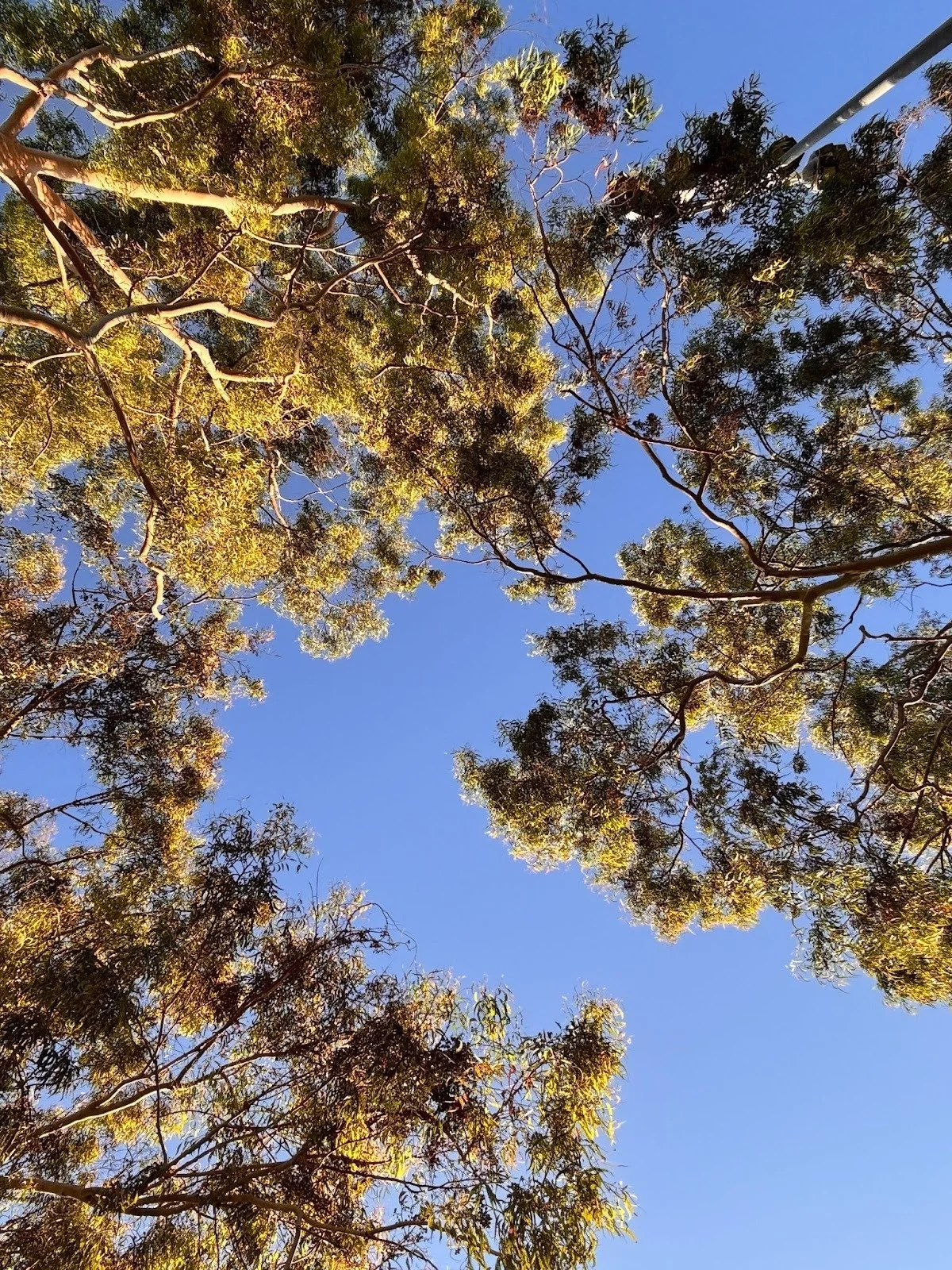
And I’m dozing off. A gust gently nips at my ankles. Grief means topaz. Topaz means December. December means death. Anatomically, the same thing. My mother’s grandmother only knew some things when she died. Her skin was papier-mache, waxy to the touch. She had slender, hollow wrists. Having empty bones means you can fly. In the real world the girls are playing cricket, pitch hair washed without mercy. Their skins glow with sweat and sunbite. They stumble. They holler. (Hold the moment steady.) Dark eyes. Dancing cataracts. Time is a starving raven.
cradled artificial earth
sky river
bordered by old life
JULIA
after George Orwell’s 1984
You saw me for the first time and saw yourself
as dead. You swore the jackboot kicked your teeth in,
smashed open your ribcage, plunged doubt into your mind.
You wanted to rip me & my sash to shreds. One day you’ll
tell me this, when your body is my body is unbodied. When
we’re sworn secret-keepers. We are the dead, you will say.
But not yet. Not yet. Not while we’re
still breathing. Not when we’ve still got
our wits with us. Not when there’s coffee
to be shared. Look, it’s the real thing. I
brought it just for you. I know. I know. My words
are real. Look. Noun-adjective-verb, I swear. My
hands are still greasy with a story. Give me your rag.
I’ve worked the hand that works reality. And most of this
is real. But I know this foxhole. I know this church, where the scar in the Earth is older than I am. In here sky is just a word. In
here brother means brother. Bug means insect. In here I will never betray you, love. I will never betray you.
POST-COLONIAL THANKSGIVING
gratefulness:
weeping rivulet
of the modern world
plymouth:
bleeding mouth
of the modern world
jackboot:
rapacious lung
of the modern world
mountain:
crumbling god
of the modern world
bison:
gutted rot-trophy
of the modern world
shilling:
despicable barter
of the modern world
missionary:
wretched sister
of the modern world
pilgrim:
bastard brother
of the modern world
mourning:
secret treasure
of the modern world
MYCORRHIZAL NETWORK
November 23, 2025 – Canyon Vista Trail
Through the mushroom ethernet, the trees
are talking. Listen closely. If you hold your breath on
one of those rare quiet spots on the Canyon Vista Trail
you can listen to their conversations. The trees are asking
each other about their day-minutes. They are sharing stories
in the new winter dark. Some of the younger saplings are sick,
so the grandmother trees send care packages. Water. Nitrogen. Carbon.
Look, listen. These two torrey pines are in love. They’ve been
in love for decades. They are among the last of their kind.
Still the tree on the left shyly coils its little root
around the mycelium telephone. Wanting. Waiting.
It might take hour-seconds for the other to respond. Love
is no speedy thing; for trees, it only travels at about a centimeter
per minute. Above the canyon, a Junco’s birdsong stitches, deftly,
through the open wound of air. Listen. The trees are opening.
The trees are opening. They are breathing alongside us.
FULL MOON NICKEL
The full moon is a silver coin...
...orbiting the earth. The full moon
becomes the first lucky nickel deposited in
Baby’s college fund. The full moon
accumulates interest over time.
Sweet, fat-cheeked Baby sways
sleepily in Papa’s lap to Baa Baa Black
Sheep. Full Moon Nickel sings
from inside the snug account. Baby
waddles and babbles. Baby learns to say
mama and dada. Baby picks up
a crayon with chubby fingers
and scribbles all over the stained &
peeling walls. Mama scrubs at the wall
until her cuticles turn red and raw to escape
the landlord’s calumny. Full Moon
Nickel beams. Baby goes to preschool
and learns the alphabet. Learns to share. Just
before kindergarten, Baby receives Dollar-store paints
and a flimsy drawing pad. Baby scribbles.
Baby doodles. Baby draws. In second grade Baby
receives a real sketchbook for Christmas. In third grade
a classmate steals the sketchbook and destroys it.
Full Moon Nickel flickers. Baby draws comics
in the corners of assignments. In fifth grade Baby’s
teacher scribbles over them with a red pen. Full Moon
Nickel shivers. In sixth grade Papa gets laid off
and Mama helps him look for work. They don’t tell Baby.
Baby sees them anyway, shadows dancing across their faces
beneath the shudder of a faulty kitchen light. Baby
turns the scene into a painting. Baby sends the painting to
a contest. The grand prize is a thousand dollars. Baby
gets runner-up and a $50 Amazon gift card instead.
Papa finds work soon after that. Full Moon Nickel
trembles. In eighth grade Baby’s art teacher recommends
Baby to a prestigious art academy on the other side of
the country. The tuition is far, far too expensive. Baby
stays home. Full Moon Nickel shrinks away.
In high school Baby only draws comics
in the corners of spiral-bound notebooks, where
nobody can see them. In sophomore year, Baby
finally decides against becoming a starving artist
and chooses to become a lawyer instead. Baby
scores a 1550 on the SATs and bright, shiny fives on
the AP exams Junior year. That summer, Baby applies
to colleges and pummels seventeen years into a 650-word
box. Baby submits applications. The family waits.
Now Full Moon Nickel is all but buried under years
of accumulated interest. Baby gets into a good-enough
school on partial scholarship. There’s just enough
in the college fund for four years. On Baby’s 18th
birthday Mama and Papa travel to the bank
to transfer the account over to Baby’s name. Baby
signs the form. That night Baby peers into the ancient
and memoried nest egg. Something is glowing from
beneath the heaps and heaps of manmade time. Baby
burrows an arm into the mound and searches for it.
It takes a minute. It takes months. Baby lives and
changes along with the nest egg. The world grows
smaller, or maybe Baby grows bigger. The search is
futile. It is the most important thing in the universe.
At long last, Baby’s hand clasps something
rocky and round. At last, Baby plucks Full Moon
Nickel from the account. It glitters in Baby’s
cupped hands like the faulty kitchen light.
Full Moon, my oldest friend.
Full Moon, my dearest friend.
Baby smiles gratefully at Full Moon Nickel,
turns it over in a still-young & hopeful palm,
and deposits the full moon back into the sky.
AFTERWORD: WHY I WRITE POETRY
I.
Dear Reader,
I truly didn’t know how to start this essay. For an entire week I wrote out draft after draft after draft and deleted everything. I drank too much coffee and stayed up too late, glaring at a frustratingly blank & bright computer screen where my thoughts refused to materialize. I felt angry with myself, not just because I couldn’t think of anything to write, but because I know you wouldn’t have wanted me to beat myself up over this.
I also didn’t know how to answer the question of why I write poetry. I could tell you exactly how I started writing poetry – I started writing my junior year of high school after developing a debilitating crush on a friend, and continued writing long after I got over it – but that still doesn’t explain why I write. Why did I turn to poetry as my medium of expression, instead of something else? What was it about poetry that spoke to me?
I think the reason why I was drawn to poetry was because of the ambiguity of the form. I had feelings that, at the time, seemed too big for me to handle directly. Poems use metaphor, simile, turn-of-phrase, abstract language, and other techniques as a form of addressing our issues without punishment. Even prose poems offer the author a cloak, a disguise to wear while displaying something deeply personal. A poem offers its author the anonymity and security necessary to shield them from the mortification of their confessionals.
I was initially drawn to poetry because it started out as a way for me to confront my feelings without the scrutiny. The more I write, though, the more I’ve come to realize the importance of confronting my feelings and my shame head-on. Now, when I write poems, I try to write them out of a desire to be honest and vulnerable. I say try because it’s a journey that’s been difficult. I’m still working on being brave enough to admit certain things. And this, like all wisdom, will come with time. It comes with time.
II.
I’ve always been eager to prove myself through my poems. It was – and still is – incredibly difficult to get published as a poet, and even more difficult for a young, amateur writer. This competition spurred me on; I was determined to be one of the few poets who beat the publishing market, who would make a name for myself as a brilliant and precocious writer before I turned eighteen. So I started a Google Doc (appropriately titled Things I’ve Written) and wrote poems as often as I could. I subscribed to a few poetry magazines and meticulously studied different forms and structures – the ghazal, the villanelle, the sonnet, free-verse, prose poems, even slam poetry. Like any good student was supposed to do, I copied from these poems. I internalized the turns and twists of language and replicated them in my own poems. I threw words at the wall until, finally, something stuck.
My first poems are garbage. I’m not afraid to admit this. They’re garbage not just because they’re poorly written, but because they’re ramblings with shiny words. I took every beautiful phrase I could think of and smashed them against each other like rocks. One of my first poems accepted for publication is titled Touch & Sky, and it is my attempt to address my relationship to my first language, Tamil. After it was accepted for publication at a prestigious youth literature magazine, I received an email from the publishers asking me to cut several lines of the poem which they perceived as unnecessary. Immediately I rose to defend my poem against this perceived threat. I felt that every line in the poem was important and necessary. I needed to say everything that crossed my mind. I needed to prove myself. I needed to verify my identity.
Siken addresses this urge beautifully in the afterword to his debut poetry collection Crush: “We want to include everything – to say all of it, and all of it at the same time. We worry that this will be our only chance to say it. Instead of trusting the reader, I had filled the poems with blather and mud.” It wasn’t until recently that I realized that perhaps the editors of the magazine may have been right. Not everything needed to be said. All of my poems thus far are Frankenstein monsters: imbalanced and lumbering things filled with rare words and nonsensical meanings. I felt the urge to write down every single line that crossed my mind: every metaphor, every anecdote, every lesson, every memory. I wanted to write these things with only the most beautiful and exquisite words I could find. I wanted to paint the image, instead of painting the illusion of the image.
Each time I moved to paint the image, however, I was struck by fear. There was so much I was ashamed of, so much I felt guilty about, and I was afraid to write about those things. What would my readers think about me? My critics? My teachers? What would my family think? The idea of airing out my dirty laundry for the world to see terrified me. It felt like I was betraying myself. If I wrote a poem about these things, I would actualize my shame, and would therefore be unable to escape it. There existed a disconnect between what I wanted my poems to be about, and what they turned out to be. I was simultaneously saying far too much and far too little.
Siken, too, faced this fear of confrontation while writing Crush: “Every time I said something that scared me, I made a joke or swerved,” he writes in the afterword. Subjects such as my contentious relationship with my culture and faith, my internalized racism, and my sexuality scared me. I wasn’t used to thinking about these things, let alone writing about them. Each time I tried to tackle these topics, I found myself swerving the vehicle away from what was almost certain to be a disaster. I felt a wild animal, trapped in the concentric circles of shame and self-censorship.
This was problematic. There’s a great essay by George Orwell titled Politics and the English Language that goes into detail about why. In the essay, Orwell critiques the ways in which writers at the time used insincere language to obscure the truth – and why this was bad, especially in post-WWII society. Orwell writes, “The great enemy of clear language is insincerity. When there is a gap between one’s real and one’s declared aims, one turns as it were instinctively to long words and exhausted idioms, like a cuttlefish spurting out ink.” (Orwell). I started writing poetry to be vulnerable; that was my real aim, as Orwell puts it. But instead of using poetry as a tool to reveal, it ended up becoming a tool to conceal. I began to use words as shields, as armor, as anything that covered myself from my own eyes. I used euphemism or abstraction to cover up the parts of myself I associated with guilt. I used familiar similes and metaphors as a crutch to conceal the shame of being. Even writing this essay doesn’t sit well with me; I feel the urge to write about easier things instead. My writing was absolutely insincere.
What I’d failed to recognize, though, was that my poems are nothing without vulnerability. By removing my shame, I’m removing myself; by removing myself, I’m alienating the reader. The reader will not see me and, as a consequence, will never see themselves. No matter how sleek the words were, they wouldn’t mean anything, because they did not come from me honestly.
III.
To say that this has been a tumultuous first quarter would be an understatement. Over the past three months, I’ve had to adjust to a vastly different environment than the one I grew up in. I’ve had to learn how to adjust to the quarter system, to a new social scene, and to a new set of academic and personal expectations. On top of this, I’ve had to grapple with love, loss, grief, mortality, and a growing sense of disillusionment with who and where I am. Is this really the life I want to lead? Do I really want to be a part of this rat race? Do I really want to pursue money and corporate approval instead of my passions? Can I really see myself as happy if I did? In the past, I felt guilty for even entertaining these questions. Now, I’m forced to tackle them.
I didn’t expect this class to be the place where I’d confront these questions. But as I learned more about the structure of the machine we all slaved for, as well as the different ways we could foster life within that machine, I found myself seeking the answers to my questions. I didn’t want my life to be neatly and perfectly planned out. I didn’t want to base my entire self-worth and identity around the rungs of a corporate ladder. I wanted to help people. I wanted things to be different. I wanted to make that difference. I wanted to live, and breathe, and be alive. What scared me was that I didn’t know how to do any of this. I didn’t know how to extricate myself from the economic hierarchy; I didn’t know how to find validation outside of the endless validation of being capitalistically successful. If I couldn’t be better than everyone else, was I even real?
In the middle of this existentializing, the class took a walk. It was sometime in early October, and you led us outside. I remember how the group congregated around you awkwardly, like a gaggle of morning geese. We weren’t used to this. You led us, and I remember the feeling of the pine needles shifting softly underneath my feet. I felt the early autumn air caressing my cheek. I walked between the sunlight and the shade and felt myself suspended above the moment, like a spider dangling from her web. I walked in the silence of a nameless trail and felt the silence of myself. I felt as though I was part of something – not a group of people, but instead as though I was part of a larger system, something that did not have a name yet encompassed everything. There was so much to hate and fear about the world when we took that walk. But there was also so much to admire, so much to feel thankful for. And so much peace. So much peace.
Impulsively, I wrote a poem (Grace) after that first walk. And then I wrote another. And then I couldn’t stop writing. After each and every setback I faced, I felt compelled to write out what I felt – what I truly felt, not the sanitized version – out on paper. This writing, to be clear, was not careless – I wrote every single line with intention. I cut out the blather and mud, as Siken writes. With each stanza, I tried to keep whatever was necessary to create the illusion of the moment. With each poem, I attempted to take everything I learned from this course and make something comprehensive out of it. Some of these poems feature myself as the subject, placed over the backdrop of today’s political exigency. Other poems are either partially or completely from the perspective of others – the violinist, for instance, or Julia from the novel.
Other poems, however, are inspired by small moments spent in nature; moments in which I was able to sit with the silence and experience the world as it was. I had initially rebuked nature poetry for being too alienated from the present political or societal moment. This quarter, however, I found myself taking inspiration from the silent meditative walks we did in class. I realized that the natural world was not a completely alien world to man-made society; rather, it was part of it. Orwell writes about this interconnectedness between nature and society in his essay Some Thoughts on the Common Toad: “[I]f we kill all pleasure in the actual process of life, what sort of future are we preparing for ourselves? If a man cannot enjoy the return of Spring, why should he be happy in a labour-saving Utopia? What will he do with the leisure that the machine will give him?” (Orwell). Nature poetry, a genre of poetry I had avoided initially, became an unexpected medium for me to confront the present. Instead of allowing politics to seep into nature, I began to see nature seeping into politics. I began to see hope diluting despair, one drop at a time. I began to see nature in myself. Even as I’m writing this essay, I feel myself being called to the garden, to the Canyon Vista Trail, to the beach, to the forest – anywhere untouched by man. Each time I go to these places, I feel more like myself.
Before this quarter, I wrote poems aimlessly. Now, I write them out of intention. I find myself being more deliberate in my writing, and more aware of my connection to the world around me. All of these poems are flowers I’ve planted in my garden – flowers that are beginning to sprout out of the dry soil. Because of this class, I’ve started to think of myself as an image, superimposed onto a moment, superimposed onto the expanse of time. I am, as Thich Nhat Hanh might say, made up of non-me materials. I am, in the end, part of everything. I am made of everyone.
The poems in this collection are the first fully fleshed out poems I’ve written in over a year. Up until this point I had written fragments and segments of poetry that never amounted to anything. Maybe they never will. But by allowing myself to be vulnerable, I’ve also learned to use these words to be more honest. To write about what I truly feel. That’s the whole point of writing poetry – to be honest with your audience, and in the process, to be true to yourself. I write poetry to be both a mirror and a window for the world. These poems may not be perfect, or even good. They probably won’t get published anywhere, either. But I’m proud of them. They house my grief, my love, and my hope. I can finally see myself in them. And I hope that you, as a reader, can see yourself in them, too.
With gratitude,
Rakshithaa